
On Algorithmic Absorption and the Rise of Post-Liberal Authoritarianism

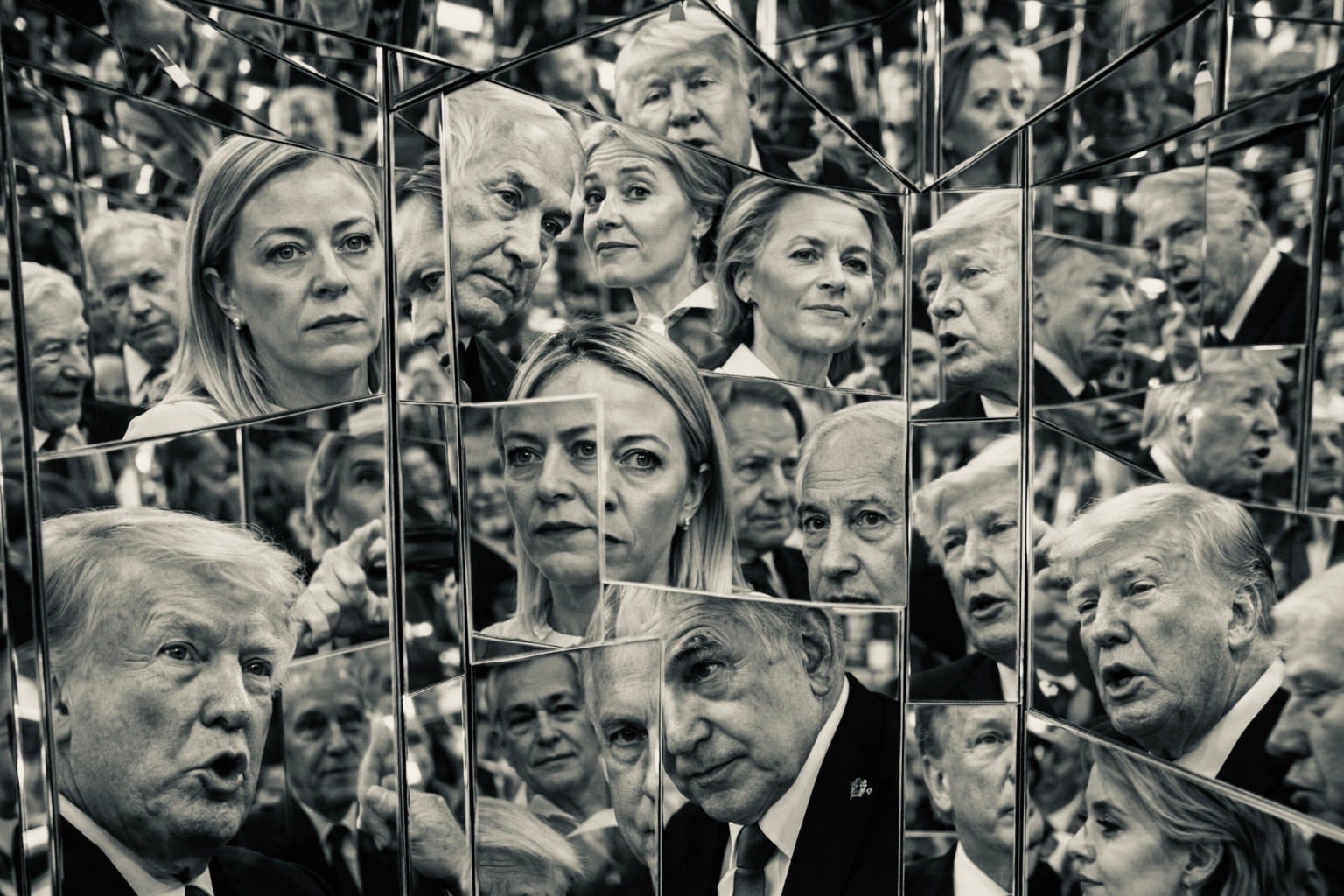
Over the past years, a pattern has become increasingly difficult to ignore. Across different political systems that formally remain democratic, a series of converging developments point toward a qualitative shift in the exercise of power.
On the geopolitical level, military interventions and acts of force that would once have required extensive public justification are now conducted with minimal deliberation and limited institutional resistance. U.S.-led military actions in Iran and Venezuela, the threat of further aggressions across Latin America, Israel’s ethnic cleansing campaign in Gaza and its sustained military operations against neighboring regions, have all been accompanied by near-automatic diplomatic and even military, and material support from the majority of European states — Germany, Italy, and the United Kingdom first in the line. This support has largely persisted regardless of mounting civilian casualties, or the clear violations of humanitarian and international law.
At the same time, within these same states, the space for domestic dissent has narrowed. Public demonstrations opposing these acts of war have increasingly been met with restrictions, bans, surveillance, and legal consequences, even when nonviolent. In several countries, expressions of solidarity with sanctioned groups or causes have been reclassified as security threats, while platforms and mainstream media have been pressured—formally or informally—to moderate content in line with state priorities.
These developments are not confined to foreign policy. Emergency powers, expanded policing authorities, preventive detention measures, and broad interpretations of public order legislation have become more common in contexts ranging from border enforcement and migration control, to climate protest, to labor action.
The net effect is not the abolition of protest as such, but its containment, deterrence, and depoliticization.
More than any single episode, what is striking is the coherence of the pattern across domains and countries. Across both Europe and the U.S, no explicit suspension of constitutional order has occurred. Elections continue to be held. Courts remain in place. Rights are formally affirmed. Yet the cumulative effect of the measures that have been recently adopted is a steady reduction in the capacity of populations to contest power, coordinate opposition, or meaningfully influence strategic decisions.
This combination—external aggression normalized, internal dissent constrained, and democratic forms preserved—poses a puzzle. Traditional accounts of authoritarianism, centered on coups, dictatorships, or mass ideological mobilization, would seem to fail to capture what is happening. At the present moment, power is not being seized against democratic institutions; it is mostly being exercised through them, while their substantive function is eroding.
The question this short essay addresses is therefore not whether Western democracies are abandoning liberal norms in principle, but whether a different political configuration is emerging in practice — a post-liberal authoritarianism in which democratic legitimacy is maintained at the level of form, while democratic agency and liberal international order are progressively hollowed out.
And, most importantly, it asks why this is happening.
Before we delve into these questions, however, we need to look more carefully at one aspect of the current sociopolitical landscape that may at first seem counterintuitive.
The Paradox
If on one hand the erosion of true democratic capacity is becoming increasingly clear, on the other, one aspect of the current moment appears nearly paradoxical: the fact that in the last few years, dissent has not been waning. On the contrary, to a certain degree, one could argue that political expression has recently become seemingly pervasive.
In fact, across social media and cultural spaces, criticism of governments, oligarchs, corporations, and institutions is continuously circulating. In several countries (particularly Italy, the UK, and the US) in the last years protests have kept erupting with increasing regularity. Moral condemnation is becoming extremely widespread and political language is saturating the web to a degree rarely seen before.
Yet, this abundance of dissent has nowhere managed to translate into corresponding political leverage. Public outrage continues to spike and dissipate. Mobilizations flare and fragment. Conflicts are named and debated extensively, but rarely if ever resolved.
Power, in other words, is being constantly challenged at the nominal level, while remaining largely untouched at the material one.
The paradox, thus, is not that people have stopped caring — that political apathy or overt repression have won — but rather that care itself is unable to accumulate into durable collective force.
The true puzzle we are asked to confront is how can political expression be proliferating, while political capacity is clearly in decline? How can dissent be nearly pervasive, and yet almost completely ineffective?
And once again, history may help us decipher it.
This configuration, in fact, is not historically unprecedented: to the contrary a remarkably similar pattern had been identified almost a century ago by a thinker writing under conditions far more overtly authoritarian than our own.
Passive Revolution, Revisited
In the late 1920s, writing from a Fascist prison cell, the Italian Marxist thinker Antonio Gramsci developed a concept to explain a puzzling political phenomenon of his time. Observing how capitalist elites had managed to absorb waves of social unrest without conceding material power or dismantling existing hierarchies—even as liberal institutions collapsed and authoritarian rule began to take hold—Gramsci sought to understand how social change could occur without revolution.
It is important to note, in fact, that for the Italian dissenter early fascism was not the capitulation of capitalism and the free market often portrayed today, but rather one of its many historical expressions: a political solution through which existing power relations were mostly reorganized, stabilized, and preserved under conditions of crisis — hollowing out democracy before its eventual collapse under the later forms of totalitarian dictatorship.
Gramsci called this process passive revolution: a mode of transformation in which social demands are selectively incorporated, cultural forms are reshaped, and institutions are reorganized, while the underlying distribution of power remains virtually intact. Rather than suppressing conflict outright, passive revolution neutralizes it by reorganizing its terrain.
Passive revolution does not primarily operate through overt repression or ideological mobilization. It instead functions by absorbing pressure rather than confronting it—by reforming language, symbols, and institutional arrangements just enough to defuse conflict, while leaving ownership, command, and strategic decision-making untouched. Change is permitted, even encouraged, so long as it does not accumulate into redistributive force.
In other words, what Gramsci identified was not the absence or failure of opposition, but a series of structural mechanisms through which opposition was rendered politically harmless.
Those mechanisms did not disappear with the fall of fascism, nor were they confined to overtly authoritarian regimes. On the contrary, over time they proved remarkably adaptable. Throughout the twentieth century, forms of passive revolution repeatedly resurfaced within formally democratic systems, mutating constantly alongside changes in media, culture, and economic organization.
In Reagan’s and Thatcher’s era, consumerism has been widely equated with freedom, shifting political desire away from collective redistribution toward individual choice. In the 1990s, the decline of the traditional socialist left was accompanied by the rise of a Third Way that succeeded in transforming language, norms, and representation, while often presiding over a large scale privatization of public services and the dismantling of unionized work. More recently, cultural inclusion has vastly expanded even as material inequality actually deepened.
Each time, the same pattern reappeared: social conflict was acknowledged, partially incorporated, and symbolically addressed — yet systematically prevented from crystallizing into true redistributive power. Crucially, change has mostly occurred at the level of culture, identity, and consumption, while ownership, command, and economic structure remained largely untouched, and in fact concentrated to new, unfathomable heights.1
What changes from one historical phase to another hence is not the logic of passive revolution itself, but the means through which it is enacted.
The question, then, is not whether Gramsci’s analysis still applies, but what forms it is taking under present conditions.
From Panopticons to Narcissicons
If we now zoom back onto more recent times, we can see that the mechanisms Gramsci described did not vanish with the twentieth century either. They rather coevolved with the media, economic, and technological environments through which social conflict has moved.
Over the past two decades, political expression has been increasingly rerouted through digital platforms whose primary function was not repression, but amplification. The advent of social media has not silenced dissent; on the contrary, it has vastly expanded its visibility. Critique, outrage, denunciation, and moral positioning have become easier to express, faster to circulate, and more tightly integrated into everyday life. Political language has migrated from parties and institutions into feeds, timelines, and profiles, where it can be continuously produced, reacted to, and displayed.
Yet this expansion of expression has coincided with a steady erosion of political leverage. As dissent has entered the procedural markets of human attention, it has been progressively individualized, aestheticized, and detached from organizational form. Visibility has replaced coordination, while political engagement has increasingly taken the form of symbolic positioning rather than collective action. Conflict has not disappeared; but it got reformatted into a stream of personalized signals that circulates widely but rarely accumulates into durable results.
If we look carefully, this phase already bore the marks of passive revolution. Social demands have been often acknowledged, different identities have been more widely recognized, and cultural boundaries have shifted — but these transformations have unfolded in ways that did not threaten ownership, command, or the distribution of material power. In other words, the attention economy has absorbed pressure by multiplying voices, while at the same time dissolving the conditions under which the voices could converge.
Much of this configuration has been analyzed through the lens of surveillance capitalism and framed using Michel Foucault’s metaphor of the Panopticon: a system in which behavior is shaped by constant observation, where norms are internalized through visibility, and where discipline operates by making subjects legible to power.
In this system, platforms tracked, measured, nudged, and optimized behavior at scale, translating attention into profit and compliance into data.
But the Panopticon presupposes a specific architecture of power: a distinction between watcher and watched, an external norm to be enforced, and a subject who conforms because they are constantly seen.
Increasingly, this architecture no longer captures the dominant mode through which control is exercised.
With the rise of large-scale machine learning systems, generative models, and continuously adaptive interfaces, a different configuration is beginning to emerge.
Individuals are no longer simply shaped by the awareness of being observed, but also by constant interaction with systems that reflect, anticipate, and respond to them in real time. Control is shifting from observation to modulation, from discipline to personalization, and from enforcement to continuous adjustment.
Perhaps, the Panopticon is giving way to (or being complemented by) a different and more efficient structure — one in which power no longer needs to watch from a central tower, because subjects are encouraged to constantly watch, narrate, and optimize themselves in perfectly customized Narcissicons that trap each and everyone inside a continuously updating and fully personalized house of self-calibrating mirrors.
The Narcissicon is not a regime of surveillance in the classical sense, but one of algorithmically mediated self-relation. In the age of AI, individuals are embedded in personalized echo chambers and feedback environments that never cease to adapt to their language, preferences, affective patterns, and cognitive habits. Each subject inhabits a dynamically tuned informational space that reflects their own dispositions back at them, reinforcing coherence, familiarity, and emotional resonance.
This architecture does not suppress expression; it intensifies it. Nor does it impose a single ideology; it fragments reality into parallel, and highly polarized experiential worlds. What it undermines instead is exteriority and collectivity: the shared reference points, narrative horizons, and frictional encounters through which political judgment and coordinated action become possible.
Crucially, the Narcissicon represents a further step towards the full industrialization of passive revolution. Where earlier mechanisms relied on mass media, consumer culture, or attention markets to absorb dissent, this configuration operates at the level of individual perception and self-construction. Conflict is not only diffused across platforms; it is personalized, privatized, and recursively stabilized within algorithmic loops that make aggregation increasingly unlikely.
In this sense, the Narcissicon does not replace earlier mechanisms of control; it perfects them. It preserves the appearance of pluralism while hollowing out collective capacity. It expands expressive freedom while quietly engineering political impotence.
What follows from this shift is not a society of passive subjects, but one of hyper-active yet isolated ones — digitally connected, extremely vocal, and yet muted by the cacophony of noise they together produce.
So Why Would Authoritarianism Be on the Rise?
It is only natural now to ask ourselves: if dissent is pervasive but already ineffective, and if formal democratic institutions remain in place, why does authoritarian power appear to be consolidating?
To answer this question, it is useful to turn to another thinker who confronted authoritarianism at its most extreme. Writing in the aftermath of the collapse of Nazi totalitarianism, Hannah Arendt argued that the decisive precondition for modern forms of domination was not mass belief, ideological fanaticism, or blind obedience, but — perhaps again counterintuitively — loneliness.
By loneliness, Arendt did not mean social isolation or the absence of interaction, but the destruction of the shared world: the loss of common reference points, shared reality, and the capacity to test one’s judgments against others.
For Arendt, loneliness was politically decisive because it dissolved the space between people — the space in which common sense, disagreement, and collective judgment can emerge. When that space collapses, individuals may remain expressive, active, and opinionated, yet become structurally incapable of acting together. Authority no longer needs to persuade or mobilize; it only needs to occupy the vacuum left by the disappearance of a shared world.
Seen through this lens, the current rise of post-liberal authoritarianism does not contradict the proliferation of widespread but ineffective dissent described above. It depends on it.
In a social environment characterized by continuous expression, personal branding, and algorithmically stabilized self-relation, individuals are rendered politically alone. The shared reality required for coordinated opposition erodes, while institutional power consolidates under the apparent cover of formal legitimacy.
The Narcissicon may thus provide the missing link between engineered political impotence and the contemporary authoritarian turn increasingly visible across Western democracies. By fragmenting common sense and weakening the ability for true collective action, the age of AI may be producing the perfect conditions under which authority can expand nearly at will without the explicit suspension of democratic forms.
What emerges then is not a society that has ceased to speak, but one that, by maximizing its loudness within digital spaces, has lost the capacity to act together in the real world — and therefore to resist.
Noticeably, in 2025 alone, the wealth of the world’s 500 richest billionaires surged by an astonishing $2.2 trillion. At the same time, global aid spending, which according to OECD was only about $215 billion in 2024, saw a further drop of 9-17%.